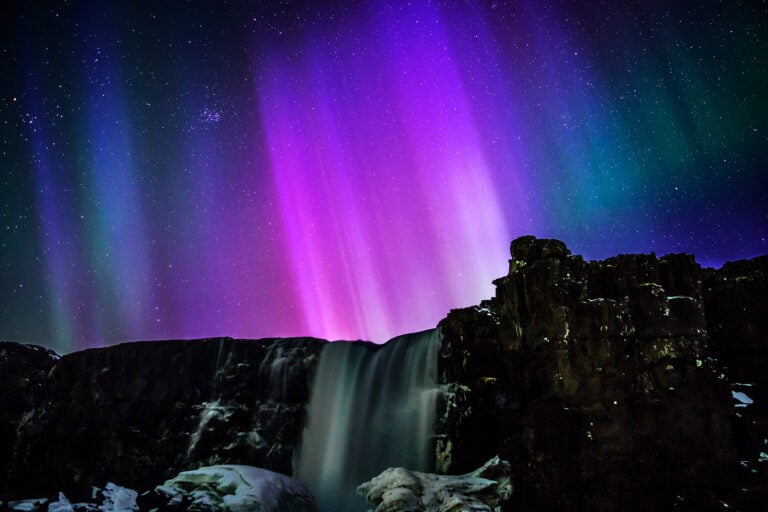
How do you photograph the Northern Lights? First, good clothes, it’s pretty cold to stand outside for a long period of time, Number two, patience, you never know, if the lights will come, or not. Third, a very good tripod, but above all a good mood, because most of the time, you don’t get a picture. The Northern Lights, despite a good forecast, don’t show themselves, except as faint streaks in the sky, and usually behind you. The the batteries in the camera should be fully charged, and the right wide angel lens, on the camera. It’s not possible to change the lens once everything starts. It’s best to use the camera in manual mode, so the you can adjust exposure and ISO in advance. Carmera on auto only works partially.
But what are the Northern Lights? Stjörnufræðivefurinn, (The Astronomy Web) has a good explanation. The Northern Lights are formed when fast-moving charged particles from the sun, mainly electrons, collide with atoms and molecules at an altitude of about 100 km above the Earth. The particles do not come directly from the sun, but rather accumulate in the Earth’s magnetosphere, flow along the magnetic field lines, and there receive the acceleration and energy needed to form the lights. When the northern lights are formed, the magnetic field vibrates. The northern lights are most often seen as veils that stretch across the sky. The veils can be hundreds and even several thousand kilometers long, but are much thinner, only a few hundred meters. The northern lights most commonly originate at an altitude of 90-130 km, but the red part of the northern lights can be measured as low as 70 km and as high as 300 km.
The Icelandic Meteorological Office, (vedur.is) provides a northern lights forecast. Therefore, if the forecast is good, you need to be in the right place at the right time… which does not exist. Because the northern lights are elusive, after almost half a century of experience chasing the northern lights, they only come to you occasionally. That’s why you look up, and say, thank you, when they show up… for once.
Photo and text: Páll Stefánsson